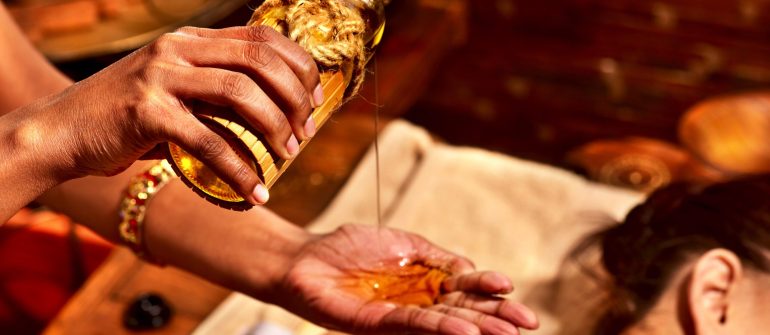
Abhyanga is a traditional Ayurvedic oil massage in which warm medicated oil is applied and massaged over the body using specific strokes. It is used as part of Ayurvedic care for relaxation, nourishment, muscle comfort, skin care, and supporting overall physical well-being.
Ayurveda describes Abhyanga as an important daily routine and explains several traditional benefits of oil massage, including nourishment of body tissues, support for good sleep, improvement of skin tone, and relief from tiredness and Vata-related aches and pains.
At Ayursh, Abhyanga is offered as a full-body Ayurvedic massage at home. The current therapy page describes Sarvaanga Abhyanga as a traditional full-body massage in which the scalp, body, and feet are massaged rhythmically using herbal oils selected according to the person’s body type.
For those looking for abhyanga massage, understanding the traditional approach, oils used, and individual treatment requirements is important.
What Is Abhyanga?
The word Abhyanga refers to Ayurvedic oil massage. Traditionally, warm medicated oil is applied over the body and massage strokes are used over different areas.
Ayursh describes its Sarvaanga Abhyanga as a head-to-toe Ayurvedic massage performed by certified Panchakarma therapists using a combination of herbal oils according to the person’s body type.
The traditional Ayurvedic description of Abhyanga associates the therapy with several concepts, including:
- deha pushti – nourishes body
- twak prasadakara – supports skin glow and complexion
- deha drudata – strengthens the body
- ruja hara – pain relief
- nidra janaka – promotes good sleep
The reference material explains that Abhyanga is traditionally associated with nourishment of body tissues, relief from tiredness and Vata-related aches and pains, improved skin tone, and promotion of good sleep.
How Does Ayurvedic Oil Massage Work?
Ayurvedic massage combines the use of medicated oil with the physical effect of massage strokes and touch.
The Easy Ayurveda reference explains the Ayurvedic understanding that herbal oils contain medicinal principles from the herbs used to prepare them. It describes the traditional view of these principles being absorbed through the skin and reaching tissues.
The reference also discusses the role of the cell membrane, explaining that it contains lipoproteins and that oils are lipid-based substances. This forms part of the Ayurvedic explanation of how oil applied during massage interacts with the body.
Massage itself also provides physical stimulation through pressure and rhythmic movements. The reference describes two components of Abhyanga: the action of the herbal oil and the effect of touch or massage.
Traditional Benefits of Abhyanga
Ayurvedic texts and the reference material associate Abhyanga with several traditional benefits.
These include supporting:
- Body nourishment
- Skin tone and complexion
- Physical strength
- Relaxation
- Good sleep
- Relief from tiredness
- Relief from Vata-related aches and pains
- Muscle nourishment
- Joint and tissue support
Ayursh’s current Abhyanga therapy page also lists relaxation, reduced muscle stiffness, improved skin smoothness, physical strength, energy, concentration, and vitality among the benefits of its therapy.
The therapy page also describes Abhyanga as helping to balance Vata Dosha, which Ayurveda associates with dryness, anxiety, and restlessness.
Abhyanga and Skin Care
Abhyanga includes the application of oil over the body, followed by rhythmic massage strokes.
Ayursh states that Abhyanga massage strokes increase blood flow to the skin and that its home Abhyanga massage supports skin smoothness and skin tone.
The reference material also discusses Ayurvedic massage in relation to skin tone and complexion.
In Ayurvedic terminology, twak prasadakara refers to supporting the healthy appearance and complexion of the skin.
Abhyanga for Muscles, Tendons, and Physical Strength
Massage is also traditionally used in Ayurveda for muscle and tissue care.
The reference explains that chronic pain can sometimes be associated with weakness of muscles and tendons, ageing, tissue degeneration, old injuries, changes in posture, and scar tissue formation. It describes Ayurvedic oil massage as one approach used to manage pain in such situations.
The reference also discusses nourishing oils such as Balaswagandhadhi thaiam in relation to muscles, tendons, and ligaments.
Ayursh’s therapy page states that warm Abhyanga oil acts as a natural lubricant and can increase joint flexibility by reducing muscle stiffness. It also traditionally associates the massage with strengthening bones and connective tissue.
Ayurvedic Oils Used for Abhyanga
The choice of oil is an important part of Ayurvedic massage. Different oils are traditionally selected according to the person’s body type, condition, and treatment requirements.
The oils associated with Abhyanga include:
- Kottamchukkadi thailam
- Chinchadi thailam
- Maha Narayan thailam
- Abhyanga thailam
- Murivenna thailam
- Balaswagandhadhi thaiam
The Easy Ayurveda reference discusses Mahanarayana oil, Kottamchukkadi oil, Mahamasha taila, and Balaswagandhadi Tailam in relation to different therapeutic purposes.
Ayursh’s current Abhyanga therapy page states that multiple herbal oils are used according to the person’s body type.
Therefore, the same oil does not necessarily have to be used for every person or every condition.
Abhyanga and Sleep
In Ayurveda, Abhyanga is traditionally associated with nidra janaka, meaning it promotes good sleep.
The reference material lists Swapna, or good sleep, among the traditional benefits of Abhyanga.
Ayursh also describes its Abhyanga massage as supporting relaxation and reducing stress and anxiety.
A relaxed body and mind can be an important part of a regular wellness routine.
Abhyanga for Different Care Requirements
Ayurvedic massage may be considered in different situations depending on the person’s condition and the advice of an Ayurvedic practitioner.
The supplied treatment requirements include Stroke Patient, Bedridden patient, and Cancer patient post chemo. These situations require individual assessment because the patient’s physical condition and treatment requirements can be different.
The focus of Abhyanga in such situations should be based on the person’s physical condition, mobility, strength, treatment requirements, and the advice of the appropriate practitioner.
Abhyanga for a Stroke Patient
A Stroke Patient may have specific rehabilitation and mobility requirements. Ayurvedic massage can be part of a broader Ayurvedic care plan when considered appropriate by the treating practitioner.
The reference material discusses oils such as Mahamasha taila in relation to muscle wasting after paralysis and Bala Taila in relation to muscle responsiveness after paralysis or palsy.
However, the choice of oil and massage technique should depend on the patient’s condition rather than applying the same approach to every stroke patient.
Abhyanga for a Bedridden Patient
A Bedridden patient can have different physical requirements compared with an active person. Positioning, mobility, skin condition, strength, and existing medical conditions should all be considered before massage.
Ayursh’s current home Ayurvedic therapy information includes Abhyanga as part of care for bedridden and immobile patients in appropriate treatment plans.
The treatment should be performed according to the patient’s condition and the instructions provided by the Ayurvedic practitioner.
Abhyanga for Cancer Patient Post Chemo
A Cancer patient post chemo requires individual consideration before undergoing massage.
The person’s current physical condition, strength, recovery status, and treatment requirements can be different from those of a person receiving routine wellness massage.
For this reason, the massage approach, oil selection, duration, and technique should be decided according to the individual’s condition and the guidance of the appropriate doctor or Ayurvedic practitioner.
Abhyanga and Vata Dosha
Ayurveda places particular importance on Abhyanga in relation to Vata Dosha.
The reference explains that oil massage helps relieve excess Vata and associated aches and pains.
Ayursh also describes Abhyanga as one of the important approaches for calming Vata.
This traditional Ayurvedic understanding is one reason oil massage is frequently included in Ayurvedic care for dryness, stiffness, tiredness, and certain types of pain.
How Abhyanga Is Performed
Abhyanga is performed using rhythmic massage strokes over different parts of the body.
The traditional method described in the reference includes different techniques according to the body area. Long strokes are used over the limbs, while circular movements are used around joints. Massage of the scalp, face, neck, chest, abdomen, back, hands, legs, and feet follows different movements.
Ayursh’s full-body Abhyanga includes the scalp and feet and is performed rhythmically using herbal oils selected according to the person’s body type.
Abhyanga and Swedana
In Ayurvedic practice, Abhyanga can be followed by Swedana, or sweating treatment, when included in the treatment plan.
The reference explains that massage treatments are commonly followed by sweating treatment such as steam therapy or poultice, according to Ayurvedic principles.
However, the post-massage procedure depends on the individual treatment protocol. It is not necessary to apply the same follow-up procedure to every person.
Abhyanga Massage at Home
Home-based Abhyanga allows the therapy to be performed in a familiar environment.
Ayursh’s current Jeevottama Ayurvedic Body Massage page describes full-body Abhyanga at home, with treatment performed by certified Panchakarma therapists using herbal oils according to the person’s body type.
The therapy page also recommends doctor consultation before taking the therapy.
Abhyanga is therefore more than a general relaxation massage. It is a traditional Ayurvedic therapy in which the oil, massage technique, duration, and treatment approach can be selected according to individual requirements.
Understanding Abhyanga as an Ayurvedic Therapy
Abhyanga combines warm medicated oil with rhythmic massage techniques and has an established place in Ayurvedic practice.
Its traditional concepts include deha pushti, twak prasadakara, deha drudata, ruja hara, and nidra janaka. It is also associated with Vata balance, nourishment of tissues, skin care, relaxation, and support for muscles and joints.
The oils used can include Kottamchukkadi thailam, Chinchadi thailam, Maha Narayan thailam, Abhyanga thailam, Murivenna thailam, and Balaswagandhadhi thaiam, depending on the treatment requirement.
For people considering Abhyanga, particularly a Stroke Patient, Bedridden patient, or Cancer patient post chemo, proper assessment is important before starting the therapy.
Frequently Asked Questions
What is Abhyanga massage?
Abhyanga is a traditional Ayurvedic oil massage in which warm medicated oil is applied and massaged over the body using rhythmic strokes. It is traditionally associated with nourishment, relaxation, skin care, physical strength, and Vata balance.
What are the traditional benefits of Abhyanga?
Ayurveda associates Abhyanga with deha pushti or nourishment of the body, twak prasadakara or support for skin glow, deha drudata or strengthening of the body, ruja hara or pain relief, and nidra janaka or promotion of good sleep.
Which oils can be used for Abhyanga?
Depending on the treatment requirements, oils can include Kottamchukkadi thailam, Chinchadi thailam, Maha Narayan thailam, Abhyanga thailam, Murivenna thailam, and Balaswagandhadhi thaiam. The oil should be selected according to the person’s condition and Ayurvedic assessment.
Can a bedridden patient take Abhyanga massage?
Abhyanga can be included in Ayurvedic care for a Bedridden patient when considered appropriate. The patient’s mobility, physical condition, skin condition, and other health requirements should be assessed before treatment.
Can Abhyanga be considered for a cancer patient post chemo?
A Cancer patient post chemo has individual treatment and recovery requirements. The person’s current condition, strength, and treatment status should be discussed with the appropriate doctor or Ayurvedic practitioner before undergoing Abhyanga.